The Joy of Sharing Dulcimer
General mountain dulcimer or music discussions
Well said, Nate! Preachin' to the choir, as they say, but very well said.
Well said, Nate! Preachin' to the choir, as they say, but very well said.
It seems a number of people have purchased dulcimers as an impulse buy, take them home with the intent of learning to play, never get around to it, and store the dulcimer away.
I have purchased no less than 6 second hand dulcimers which appeared to have been played little if at all. One had the pick and noter sealed in a little envelope which had never been opened and the string sale tag still tied to the instrument.
So it is possible to get a "used" dulcimer which has not been used much at all.
Cardboard dulcimers can sound SURPRISINGLY GOOD!
I know I'm shooting myself in the foot when I say that, being a builder of dulcimers, but it's true.
I just got back from a camping trip where I brought a dulcimer. Plucked by the lake and the campfire and it was a great time. While out there, a friend remarked that it sounds nice and told me what so many people have told me during conversations about music. "I've never been any good."
Every time I hear this it's like a dopamine rush because I know certainly that if I put a dulcimer in their hands, explain to them the Do-Re-Mi scale as I move up the melody string frets, and then show them that every chord they can play will always be harmonious, they will be enthralled and within 30 seconds their musical confidence will have skyrocketed. Sure enough he was having fun with different rhythms, playing bizarre chords as far as his hands could stretch just to see what they sound like, and once he realized he could barre chords using a lighter as a slide, he was in bliss.
It's an experience I've had many times. I often sling my primitive dulcimers on my back and walk to the river, and along the way people often inquire about it. I really do relish in persuading people who think they lack musical ability to go ahead and try playing. Without fail people who have had really bad experiences with hard to learn instruments get so invested in playing my dulcimer its hard to get it back, and in fact a couple times, they purchased it from me on the spot because the music they made with it spoke to them.
I get a ton of joy from introducing american history enthusiasts, art appreciators, and those who need a boost of musical confidence to my dulcimers. It is so accessible to beginners and is simply gorgeous in the hands of a master.
In my opinion the dulcimer should replace the recorder as the 'student instrument' given that it's so much more likely to spark a love for music. I think if everyone had access to a dulcimer, almost everyone would be a musician :)
I know people who play finger style on 12-string guitars. A particular style, if you don't know it already, is only as hard as you make it. That said, the simple solution is as Strumelia suggests -- remove one of the doubled melody strings.
BTW there's rarely anything wrong with picking up a gently used dulcimer. I suspect most people are 'thinning the herd' so they can finance another purchase...
If you were really dense, @sunvalleylaw, you wouldn't apologize. And there's nothing to apologize for anyway. Unlike Facebook, which has the endless scroll that keeps moving, we try to maintain discussions and forums so they can be searched and used later on.
A couple of posts earlier, @ken-hulme posted a link to an article he wrote: Ken Hulme's "I Just Got A Dulcimer, Now What?" Article - Strumelia | fotmd.com . The link is actually to a discussion about that article, but the first post in the discussion by our fearless leader @strumelia has a link to a pdf of the article. Just follow the link above, scroll to the bottom of the discussion to find the first post, and you'll see that pdf link.
@dusty-turtle, sorry to be dense, but navigation here is a little different from some other forums I am used to. Which very first post? In this thread? Sorry, still missing it. :(
EDIT: I followed the link, and I there is a post by @strumelia introducing the article, but that is all that is there. Nothing to scroll down to and no other active link that shows up for me.
EDIT to my EDIT: Never mind. I figured it out. I had to join the “Beginners” group before the content showed up. I am starting to figure out how to get around here. I also joined a couple other groups, such as the modern/chording one, in which I have interest. Cool place!
Thanks folks! Will check out Berman’s work too. As I do want to I learn a little bit about more traditional playing. But after paging through last night, am really excited for Joellen’s too. And it appears that she signed it, and sent a nice little email when she shipped my order. Very nice!
I want to learn some traditional, for the learning of it, but in no way want to stop at that and plan to be percussive and experimental, and even add jazz tones and notes in if I can find them. And I like mixing in foundational “beginner” concepts that can always be reaffirmed, with more advanced concepts, and I know a lot of theory and the guitar fretboard and piano keyboard already, so would not want a beginners only book. I would get bored with that. BUT, it is important to consider ergonomic body and hand mechanics, fretting and strumming techniques, staying in time, etc. and expand as I go and become familiar.
Thanks for the input!
I don't know anything about the Lapidus book yet, I believe, Joellen Lapidus introduced Joni Mitchell to the mountain dulcimer and to using the mountain dulcimer percussively.
A group whose music I really like, Appalasia, has a mountain dulcimer player who is also a percussion player-- Jeff Berman. He uses the mountain dulcimer in a percussive fashion, too. http://appalasia.com/bios
@sunvalleylaw, that book is by Joellen Lapidus, who was a pioneering dulcimer player and maker several decades ago and is still active and influential today. Her book is one of the few that mixes stuff for beginners with very advanced material on rhythmic strumming and chords and stuff. It will serve you very well. Joellen still plays both traditional songs in a drone style and other jazzy stuff with chords. She also experiments with different tunings, more than most people, I think. I'm sure you'll learn a lot there, although you should keep your eyes open for other instructional material that might be free online. And of course, when you're ready, you can contact Joellen directly or find her at a dulcimer festival.
@sunvalleylaw, the article is in a link in the very first post. Follow Ken's link and then scroll to the bottom where you can find that first post. You'll find the article there.
Thank you, @ken-hulme. Would love to read it. However, they link seems to take me to a place mentioning the article, but not including it. Do you have a different link, or am I doing something wrong at that link? Thanks!
Steve
You can always simply remove one of the doubled pair of melody strings if you want just single strings, people do it all the time. Remove the one that will result in string spacing you like.
$200 is extremely low for a new dulcimer that is not a cardboard model. If you can set your budget to $300 or $350 you will have additional options. Or, used dulcimers will be a bit cheaper.
That said, most of the cardboard dulcimers sold these days are actually pretty good dulcimers, they play smoothly and they sound nice. They make great super-low-priced starter instruments that remain useful later on for travel and camping, etc.
Ya got $200, and you wanna get a decent new (not used) dulcimer.
You're interested in learning to play all styles, especially fingerstyle, but also with noter, chords, etc.
I've looked at Berg's, but they're all 4 and 5-string instruments- but definitely in my price range.
Recommendations?
I understand (perhaps incorrectly) that fingerstyle playing is difficult with doubled strings?
I am interested in modern chord style, rhythmic, percussive style, probably some alternate tunings. I picked myself up this book. Is this a good resource?
Any other suggestions?
Thanks!
Steve.
Here's the link to an article/pamphlet I wrote years ago called I Just Got A Dulcimer, Now What? It's an illustrated glossary of dulcimer terms (so we all speak the same jargon (often different from guitar), plus answers to many beginner questions about tuning, playing, care and feeding of your new instrument.
Ken Hulme's "I Just Got A Dulcimer, Now What?" Article - Strumelia | fotmd.com
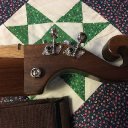
Thanks, Ken, for the suggestion! I had already checked out what Richard and FolkCraft had put up on YouTube, and put it on the back of the scroll head. BUT, if I end up wanting to have another option, I could always put another one on the side like you have in the pic. Taking this on a family trip to Hood Canal, WA and will just mess around with it and get acquainted for a bit. I am bringing some sand paper and a block of wood to see about the action if I find time.
Nice dulcimer, Steve! Great name!
Here is some more dulcimer good news: https://stonecountyleader.com/stories/dulcimer-reclaimed-after-50plus-years,4160
Ken
"The dulcimer sings a sweet song."
Thanks for introducing yourself, Steve. Here is a suggestion for installing your strap buttons. If you play with the dulcimer flat on you lap, put the strap button on the peg head end on the side of peg head on the side opposite your playing. This will put the head of the dulcimer in toward you and make it more stable when playing. If you play with the dulcimer tilted in front of you (from stomach to thighs), the strap button on the peg head end works better in the middle of the underside of the peg head near the body. Here is a photo of the first suggestion later this afternoon.
Ken
"The dulcimer sings a sweet song."
@sunvalleylaw Good to have you here, Steve! The mountain dulcimer journey is a fun one. So cool you got to see Tim H play md with Brandi-- love her and the band!
Howdy, Steve! A warm welcome to you here!
That's a beautiful dulcimer you have.
We'll try to help and encourage you in your activity. Just let us know what you need, and we'll see what we can do.
Hi folks! My first name is Steve. Long time guitar player (dad hack, nothing too fancy), mostly rock oriented styles, with jazz influences. Interested in the M. Dulcimer as a rhythm, percussion instrument with melody possibilities and different tones from guitar. Ala Joni Mitchell. Got turned on to this by watching signer/songwriter Brandi Carlile and her band perform a campfire acoustic version of “All I Want.” On a super, super hot day in Western Wa a few weeks back. Her guitarist, Tim Hanseroth, looked like he was having a ton of fun on his mountain dulcimer, and I decided I needed to try it!
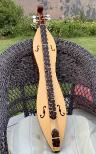
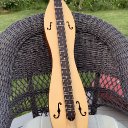
I went and found the 1998 FolkCraft CF-300 you see in my profile pic (not sure why it is sideways sometimes, I keep fixing it). It had been purchased new and not really ever played, and stuck in a closet or something. Paduk back and sides, spruce top, maybe wenge fretboard? Action is too high, particularly toward the bridge, so I need to fix that, and put my strap buttons on, but it sounds and looks really nice otherwise!
Came here to learn how to care and take care of these things, get ideas on learning to play, and just connect!
Cheers and happy Friday!
What Banjimer said! Just tune it and play. If you need encouragement or help, just give us a hollar and we can help. A number of us here have been playing Noter & Drone style for decades...
Yes, you can play your McSpadden in D-A-A without changing the bridge. The compensated bridge improves intonation slightly, but it is not essential. In fact. most dulcimers do not have a compensated bridge.
Hi, there! About a year ago, I bought a McSpadden - standard 26" VSL and I love the sound. I am a relatively new player and my intention has been to play chord melody in DAD. However, I'm now wanting to play noter drone in DAA. I'm finding out now that in order to play a McSpadden in DAA, I need a "bridge compensation." Can I still play my McSpadden in DAA without this?
Thanks!
@carla-maxwell It wonderful you got to meet Larkin! I imagine her book and accompanying recording have been a help for many on their journey of playing mountain dulcimer
My apologies for the odd spacing on the posting! I have tried to compact things yet have not been entirely successful. I hope you like reading the tribute to Larkin!
That was lovely. I didn't know her very well but appreciated Larkin's talent and kindness. Larkin was my first dulcimer teacher. Her beginner dulcimer workshop at the Memphis Dulcimer Festival was perfect for me, and I learned from her beginner book and accompanying cassette tape after that. I was very sorry to hear the sad news.
Friends, the international day event called Play Music On The Porch Day is always the last Saturday in August-- not far away. Do you have your tune chosen yet? If not, you have plenty of time and can even decide on a tune at the last minute. :)

I don't have a tune picked out, but I'm looking forward to international Play Music on the Porch Day. PMOTPD was a beautiful day last year and a lot of fun to be a part of the worldwide event.

That is a neat story, Ken! Thanks for posting the link!
What a sweet story, @ken-longfield. It shows how strong the student/teacher bond can be and also how dulcimers bring people together in so many ways.
This is a delightful story: https://www.southbendtribune.com/story/lifestyle/2021/07/18/student-teacher-reunite-over-dulcimer-built-woodworking-class/7970945002/ I hope you enjoy it as much as I did.
Ken
"The dulcimer sings a sweet song."
Back in 1971 I had a cheap what some call a bottle cap banjo. A good Vega banjo was around $300. I could not afford one. Then 30 years later they were in the one to three thousand dollar range. I thought I could build a shop and build my own for less. I did!. I've got long necks, short scale, normal scale, fretless, semi fretless, six string. 10" , 11" , 12" pots , block rims, plywood rims, brass tone rings, wood tone rings. I had to restrain myself from building more and focus on dulcimers. All together they cost me about the same as one high quality open back banjo....Robert
There's nothing like a fretless gourd or wood-shell banjo, strung with gut or nylon strings, with a natural skin head, to make the world go 'round!
Steven, I pretty much agree with this. Though I do love some of my oldtime steel string banjers too, they have their own pretty bell-like tone appeal. 
@Strumelia I do know jeff menzie I have placed several orders for skins from him I love his builds on this gourd banjos even though I do not have one of his
My current banjos which are both open back is a 11 inch Bart Rieter Grand Concert and a Rickard 11 inch maple whyte LAYDIE the Rickard I installed a John Balch pre mounted jeff menzie goat skin head in my experimenting with bridges I ended up with a Doc Huff old time bridge which weighs 7.3 grams
That is the other thing I learned while experimenting with bridges weight means nothing
I also am building a gourd banjo for myself that I hand carved the neck out of zebra wood
The banjo I am having built by a local luthier I supplied the wood to him which the rim is made out of bocote the neck will be laminated paduk with a purple heart center strip and overlayed with a pale moon finger board it will also be a long neck which I elected to have fretless
There's nothing like a fretless gourd or wood-shell banjo, strung with gut or nylon strings, with a natural skin head, to make the world go 'round!